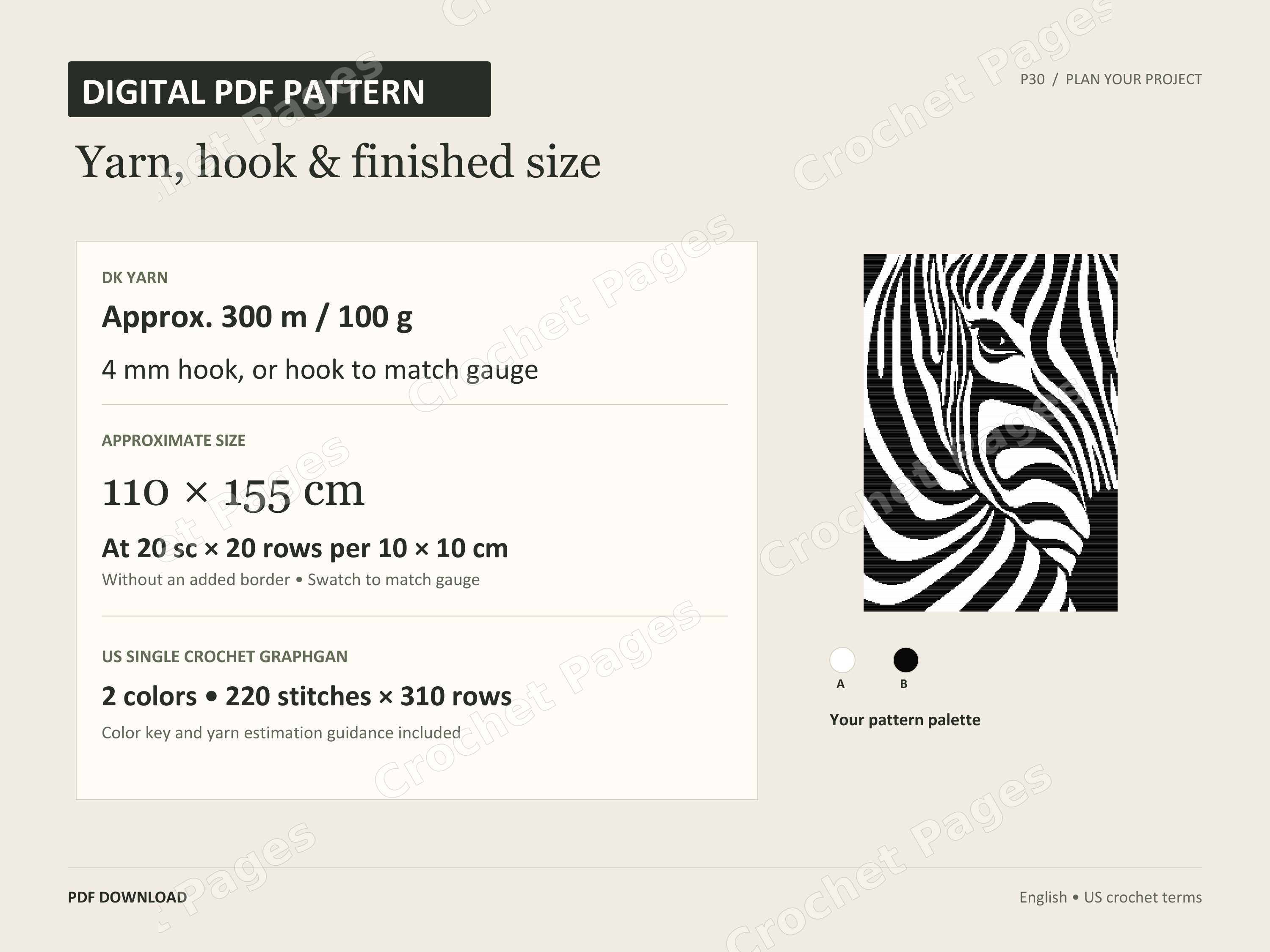
A graphgan is a crochet blanket that shows a picture. The picture comes from a chart: a grid of colored squares where every square is one stitch. If you can count squares and change colors, you can crochet any graphgan, from a simple heart to a full cat portrait. This guide explains how to read a graphgan chart, how written rows relate to the grid, and which mistakes cost beginners the most time.
What a graphgan chart actually is
A chart is a pixel image. Each cell is one single crochet stitch, and each row of cells is one row of your blanket. A 150 × 200 chart therefore means 150 stitches across and 200 rows tall. Designers usually add numbers along the edges so you can find your place, and a color key that lists how many stitches each color needs, which is how you estimate yarn.
Most graphgan patterns, including the blanket and graphgan patterns at CrochetPages, come as a PDF with three parts: a full color chart, the same chart split over several pages at a readable size, and written row-by-row instructions such as “Row 12: 14 white, 3 black, 22 white”.
Which direction do you read the chart?
Charts are read from the bottom up, because that is how the blanket grows. Row 1 is the bottom row of the picture.
- Odd rows (right side) are read from right to left.
- Even rows (wrong side) are read from left to right.
This zig-zag matches the way you turn your work at the end of every row. If you are left-handed, reverse the directions; the picture will come out mirrored, which rarely matters unless the design contains letters. Written instructions already follow the correct direction for right-handed crocheters, so if you use them you do not need to think about this at all.
Step by step: your first chart row
- Chain the number of stitches across the chart plus one turning chain. For a 150-stitch chart that is 151 chains.
- Work the first row of single crochet in the color shown in the bottom right cell, changing color exactly where the chart changes.
- At the end of the row, chain one and turn. You are now on an even row, reading left to right.
- Mark every finished row with a pencil on a printed chart, or move a sticky note up one row. Losing your row is the most common graphgan mistake.
How to change colors cleanly
Change colors on the last pull-through of the stitch before the new color. Insert your hook, yarn over with the old color, pull up a loop, then yarn over with the new color and pull through both loops. The new color now sits on top, ready for the next stitch. Doing it one stitch late shifts the whole picture by one cell, which is very visible on faces and outlines.
Tapestry, intarsia or bobbins: three ways to carry yarn
- Tapestry crochet carries the unused color inside the stitches. Fastest and reversible, but the carried color can peek through on pale sections. Works best with few colors.
- Intarsia uses a separate ball or bobbin for every color block and drops it at the back. Cleanest picture, most ends to weave in. Best for designs with large solid areas.
- Hybrid carries colors for short gaps (under five stitches) and uses bobbins for long gaps. This is what most experienced graphgan makers end up doing.
How big will the blanket be?
Single crochet stitches are a little wider than they are tall, so a square chart produces a slightly wide rectangle. With worsted weight yarn and a 4 mm hook, most people get about 4 stitches and 4.5 rows per inch. A 150 × 200 chart is then roughly 37 × 44 inches, a generous throw. Always crochet a 20-stitch, 20-row swatch first and measure it; adjusting the hook size by half a millimeter is far easier than adding a border to fix the proportions later.
Reading tips that save hours
- Print the split chart pages and tape them together, or open the PDF on a tablet and zoom in. A phone screen is too small for a 150-stitch row.
- Use stitch markers every 10 or 25 stitches. If a row is off, you only recount a short section.
- Count the stitches at the end of every row for the first ten rows until the habit sticks.
- Work in daylight or under a white lamp. Dark blues, blacks and purples look the same under warm light.
- If the pattern includes written rows, read them aloud or use a row-counter app; it is easier than counting cells.
Where to find charted blanket patterns
Every pattern in the CrochetPages blanket collection comes with a numbered chart and written rows in English, and the wall hanging patterns use the same technique on a smaller grid, which makes them a good first project. If you prefer a design that does not use color changes at all, look at mosaic crochet patterns, where one color per row creates the picture.